
Choose the indication you’d like to view
In unresectable Stage III NSCLC
IMFINZI following CRT offers the best chance for long-term survival in a curative-intent setting1-5
2-year primary overall survival analysis: Median overall survival (mOS) not reached with IMFINZI vs 28.7 months with placebo (HR=0.68; P=0.0025)1*
5-YEAR POST-HOC OVERALL SURVIVAL UPDATE3†
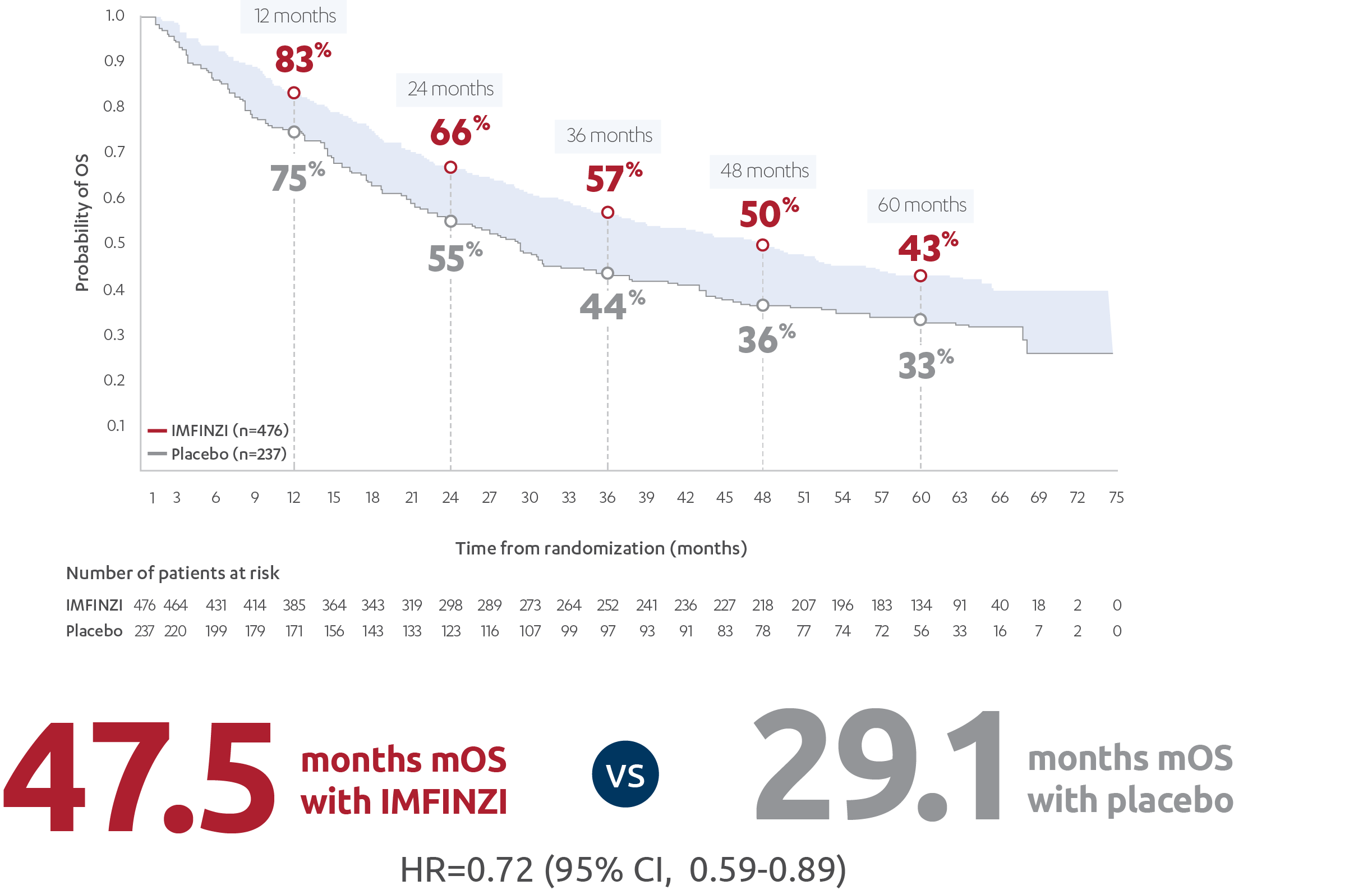
- In the post-hoc survival analysis, half of the patients who received IMFINZI after CRT were alive at 47.5 months (HR=0.72; 95% CI, 0.59-0.89)3
- The post-hoc 5-year OS analysis was conducted at ~5 years after the last patient was randomized, and was not powered to show statistical significance3
- 43% of patients who received IMFINZI after CRT were alive at 5 years as were 33% of patients who received placebo after CRT3
- Serious adverse reactions occurred in 29% of patients receiving IMFINZI and 23% of patients receiving placebo. The most frequent serious adverse reactions (≥2%) with IMFINZI were pneumonitis or radiation pneumonitis (7%) and pneumonia (6%)1,6
- Fatal pneumonitis or radiation pneumonitis and fatal pneumonia occurred in <2% of patients and were similar across arms1
- Pneumonitis or radiation pneumonitis led to discontinuation in 6% of patients receiving IMFINZI1
Learn more about IMFINZI for unresectable Stage III NSCLC following CRT
BICR=blinded independent central review; CI=confidence interval; CRT=chemoradiotherapy; DoR=duration of response; ES-SCLC=extensive-stage small cell lung cancer; HR=hazard ratio; KM=Kaplan-Meier; NR=not reached; NSCLC=non-small cell lung cancer; ORR=objective response rate; OS=overall survival; PFS=progression-free survival; RECIST=Response Evaluation Criteria in Solid Tumors; TTDM=time to death or distant metastasis; WHO=World Health Organization.
Study design: The PACIFIC study was a large, Phase III, randomized, double-blind, placebo-controlled, international study of 713 patients with unresectable Stage III NSCLC who had not progressed following concurrent, platinum-based CRT. Patients had completed at least 2 cycles of concurrent CRT within 42 days prior to initiation of the study drug and had a WHO performance status of 0 or 1. Randomization at enrollment was stratified according to age, sex, and smoking history. Patients were randomized 2:1 to receive 10 mg/kg of IMFINZI or placebo every 2 weeks for up to 12 months or until unacceptable toxicity or confirmed disease progression. Coprimary endpoints were PFS (measured based on RECIST v1.1 criteria by BICR) and OS. Secondary endpoints included: percentage of patients alive without disease progression at 12 and 18 months, ORR, DoR, and TTDM.1,6
*The primary 2-year OS analysis was conducted after 299 deaths for 42% maturity (61% of targeted events) with a median follow-up of 25.2 months. Reduction in the risk of death vs placebo was 32% (95% CI, 0.53-0.87) with a log-rank test stratified by sex, age, and smoking history. Median OS was NR with IMFINZI (95% CI, 34.7-NR) vs 28.7 months with placebo (95% CI, 22.9-NR).1,2
†The post-hoc 5-year OS analysis was conducted at ~5 years after the last patient was randomized, and was not powered to show statistical significance. Median OS was 47.5 months with IMFINZI (95% CI, 38.1-52.9) vs 29.1 months with placebo (95% CI, 22.1-35.1). Reduction in the risk of death vs placebo was 28% (HR=0.72; 95% CI, 0.59-0.89) with a log-rank test stratified by sex, age, and smoking history. OS rates with IMFINZI vs placebo were: 83% (95% CI, 79.4-86.2) vs 75% (95% CI, 68.5-79.7) at 12 months, 66% (95% CI, 61.8-70.4) vs 55% (95% CI, 48.6-61.4) at 24 months, 57% (95% CI, 52.0-61.1) vs 44% (95% CI, 37.1-49.9) at 36 months, 50% (95% CI, 45.0-54.2) vs 36% (95% CI, 30.1-42.6) at 48 months, and 43% (95% CI, 38.2-47.4) vs 33% (95% CI, 27.3-39.6) at 60 months.3
















 This product information is intended for US Healthcare Professionals only.