

EFFICACY

What were the efficacy results in the POTOMAC study?

Disease-free Survival (ITT)

In BCG-naïve, HR-NMIBC

What were the disease-free survival results seen in the POTOMAC study?

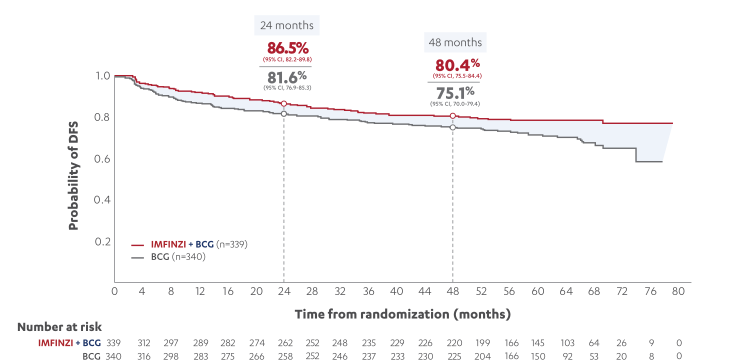
IMFINZI + BCG: A chance for a durable DFS benefit1,2

  • Median DFS was not reached with IMFINZI + BCG (95% CI, NR-NR) nor with BCG (95% CI, 74.0-NR).1,2

SIGNIFICANTLY IMPROVED DISEASE-FREE SURVIVAL* (primary endpoint)1-3

32% Reduction in Risk of an Event

REDUCTION IN RISK OF recurrence of high-risk disease OR DEATH* with IMFINZI + BCG vs BCG alone ​(HR=0.68 [95% CI, 0.50-0.93]; P=0.0154)

32% Reduction in Risk of an Event

REDUCTION IN RISK OF recurrence of high-risk disease OR DEATH*

with IMFINZI + BCG vs BCG alone ​(HR=0.68 [95% CI, 0.50-0.93]; P=0.0154)

Disease-Free Survival Chart

Refer to: DeSantis et al. Lancet. 2025.

Disease-Free Survival Chart

Refer to: DeSantis et al. Lancet. 2025.


SCROLL

  • At the data cutoff of April 3, 2025, median follow-up was 60.7 months in all censored patients1,2
  • Landmark DFS rates at 24 and 48 months were exploratory and were not powered to determine statistical significance2,3

DFS EVENTS1†

  IMFINZI + BCG
(n=339)
BCG
(n=340)
Number of events (%) 67 (20) 98 (29)
Recurrence of
HR-NMIBC
36 (11) 52 (15)
Persistent CIS 1 (0.3) 2 (0.6)
MIBC and/or
metastatic disease
16 (4.7) 15 (4.4)
Death 14 (4.1) 29 (9)

NCCN

RECOMMENDED

The first and only National Comprehensive Cancer Network® (NCCN®) recommended systemic IO + BCG regimen for certain BCG-naïve patients with HR-NMIBC

Durvalumab (IMFINZI®) + BCG is a Category 2A treatment option for certain BCG-naïve patients with HR-NMIBC4‡

See the NCCN Clinical Practice Guidelines in Oncology (NCCN Guidelines®) for detailed recommendations, including other recommended treatment options.4

NCCN=National Comprehensive Cancer Network® (NCCN®).

*DFS was defined as the time from the date of randomization until the date of first recurrence of HR-NMIBC, persistent CIS, MIBC and/or metastatic disease, or death.1

DFS was investigator assessed.1

Disease-free Survival (subgroups)

In BCG-naïve, HR-NMIBC

What were the disease-free survival results across prespecified patient subgroups in the POTOMAC study?

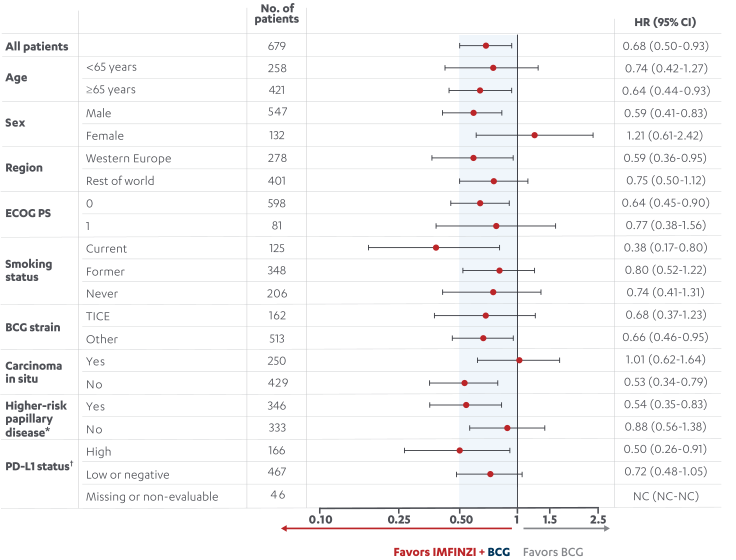
DFS BY PRESPECIFIED PATIENT SUBGROUP (exploratory analysis)1,3
Disease-free Survival Results in the POTOMAC Study
 

SCROLL

Refer to De Santis, et al. Lancet. 2025.

*Higher-risk papillary disease was defined as HG/Grade 3 T1, or multiple and recurrent and large tumors (diameter ≥3 cm).

PD-L1 status was determined by the percentage of tumor cells with any membrane staining above background or by the percentage of tumor-associated immune cells with staining at any intensity above background; ICP represents the percentage of tumor area occupied by any tumor-associated immune cells; IC+ represents the percentage area of ICP showing PD-L1–positive immune cell staining. PD-L1 status was considered high if any of the following criteria were met: ≥25% of tumor cells showed membrane staining; or ICP was >1% and IC+ was ≥25%; or ICP was 1% and IC+ was 100%.

The DFS prespecified patient subgroup analysis was not powered to show differences between or within individual subgroups and was not powered for statistical significance.

Across 679 patients treated with IMFINZI + BCG or BCG alone

62% of patients were  65 Years Old
51% of patients had higher-risk papillary disease
51% of patients had higher-
risk papillary disease

Overall Survival

In BCG-naïve, HR-NMIBC

What were the overall survival results from the POTOMAC study?

OVERALL SURVIVAL (OS at 5 years was an exploratory secondary endpoint)5

19% REDUCTION IN RISK OF DEATH
with IMFINZI + BCG (HR=0.81 [95% CI,
0.54-1.19])
. Median OS was not reached with IMFINZI + BCG (95% CI, NR-NR) nor with BCG
(95% CI, NR-NR)5 A final OS analysis was conducted after the last patient had been followed for a minimum of 5 years. Exploratory OS results showed there were 45 deaths (13.3%) in the IMFINZI + BCG arm and 56 deaths (16.5%) in the BCG alone arm.5
OS analysis was exploratory and was not powered to determine statistical significance.2,5

At data cutoff of October 3, 2025, median duration of follow-up was 71.5 months (range: 0.1-87.0) in the IMFINZI + BCG arm and 71.7 months (range: 0.6-86.3) in the BCG arm.5

Study Design & Baseline Characteristics

In BCG-naïve, HR-NMIBC

How was the POTOMAC study designed?

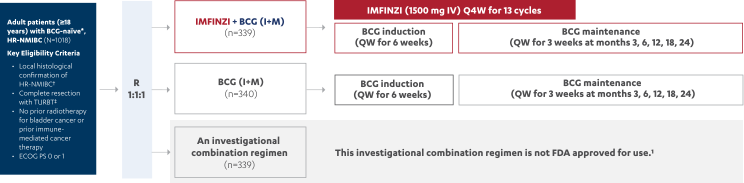
POTOMAC was a large, global, open-label, randomized Phase III trial2

High-risk NMIBC disease was defined as at least one of the following: T1 tumor, HG/Grade 3 tumors, CIS, or multiple and recurrent and large tumors (diameter ≥3 cm)1,2

THE POTOMAC STUDY: PATIENTS WITH BCG-NAÏVE*, HR-NMIBC2

Patient Results With BCG-naïve, HR-NMIBC Chart
 

SCROLL

Stratification factors2:

  • Higher-risk papillary disease, defined as HG/Grade 3 T1 or multiple and recurrent and large tumors (diameter ≥3 cm)
  • CIS

Disease-free survival was defined as1:

  • The time from the date of randomization until the date of first recurrence of HR-NMIBC, persistent CIS, MIBC and/or metastatic disease, or death

Primary endpoint1,2:

  • Investigator-assessed disease-free survival (DFS)

Select secondary endpoints2:

  • Overall survival (OS) at 5 years, DFS at 24 months, time to MIBC/metastatic disease, and time to cystectomy

*BCG-naïve patients were defined as those who had not received prior intravesical BCG or who previously received but stopped BCG therapy more than 3 years before study entry.1,2

High-risk defined as T1 tumor, HG/Grade 3 tumors, CIS, or multiple and recurrent and large tumors (diameter ≥3 cm).1,2

Patients with residual CIS after TURBT were eligible.2

See dosing for the POTOMAC Regimen

What were the baseline characteristics of the POTOMAC study population?

IMFINZI + BCG was evaluated across a broad range of BCG-naïve, HR-NMIBC patients2

Baseline characteristics were well balanced across treatment arms2

BASELINE CHARACTERISTICS (ITT)2

Baseline characteristics IMFINZI + BCG
(n=339)
BCG
(n=340)
Median age (IQR), years 68 (61-74) 67 (61-73)
Sex (%)
Male
Female

81
19

80
20
Region (%)
Western Europe
Rest of world

42
58

40
60
ECOG PS (%)
0
1

87
13

89
11
Smoking status (%)
Current
former
Never

18
52
30

19
51
31
Race (%)
White
Asian
Other
Missing

79
18
1
2

79
18
2
1
Ethnicity (%)
Hispanic or Latino
Not Hispanic or Latino

5
95

3
97
Disease stage (%)
Ta*
T1*

33
58

29
62
CIS ± papillary disease (%) 37 37
Papillary disease only (%) 64 65
PD-L1 expression (%)
High
Low/negative
Missing/not evaluable

24
69
7

25
68
7

~62% of patients
in the POTOMAC study were
≥65 years old

~64% of patients
in the POTOMAC study
had papillary-only disease


SCROLL

AUA risk classification across both arms in the POTOMAC study1

81% of patients had high-risk disease
16% of patients had intermediate-risk disease
3.7% of patients had risk-undetermined disease

*Data represent patients who had papillary disease (with or without CIS).2

Data represent patients who had CIS (with or without papillary disease) at baseline.2

PD-L1 status was determined by the percentage of TC staining; ICP represents the percentage of tumor area occupied by any tumor-associated immune cells; IC+ represents the percentage area of ICP showing PD-L1–positive immune cell staining. PD-L1 status was considered high if any of the following criteria were met: ≥25% of TCs showed membrane staining; or ICP was >1% and IC+ was ≥25%; or ICP was 1% and IC+ was 100%.2

Key Points for IMFINZI Efficacy

IMFINZI + BCG demonstrated a significant improvement in DFS compared to BCG alone1,2

  • 32% REDUCTION IN RISK OF recurrence of high-risk disease OR DEATH* was seen with IMFINZI + BCG vs BCG alone (HR=0.68 [95% CI, 0.50-0.93]; P=0.0154)1,2
  • Median DFS was not reached with IMFINZI + BCG (95% CI, NR-NR) nor with BCG (95% CI, 74.0-NR)1

*DFS was defined as the time from the date of randomization until the date of first recurrence of HR-NMIBC, persistent CIS, MIBC and/or metastatic disease, or death.1