
Metastatic NSCLC is a heterogeneous disease known to have varied pathological characteristics1
First-line mNSCLC response may be affected by the presence of certain biomarkers
PATIENT CHARACTERISTICS, INCLUDING HISTOLOGY, THAT MAY INFLUENCE TREATMENT OF mNSCLC2,3*

- HISTOLOGY (%)
- - NONSQUAMOUS (67%)
- - SQUAMOUS (27%)†
- - OTHER (6%)
- AGE
- TOBACCO USE
- PERFORMANCE STATUS
*SEER statistics for all-stage NSCLC based on Cancer of the Lung and Bronchus, Percent Distribution and Counts by Histology Among Histologically Confirmed Cases, 2013-2017 (both sexes and all races).2
†Includes squamous and transitional cell carcinoma.2
PATIENT CHARACTERISTICS, INCLUDING FREQUENCY OF SELECT TUMOR BIOMARKERS, THAT MAY INFLUENCE RESPONSE4‡§

PD-L1 EXPRESSION <1% (~21%-43%)||
PD-L1 EXPRESSION 1%-49% (~21%-40%)||
PD-L1 EXPRESSION ≥50% (~12%-17%)||
‡Frequent comutations in a retrospective database analysis of 1261 patients with advanced lung adenocarcinoma: 10.9% of patients had tumors that are STK11-mutant and KRAS-mutant; 9.4% of patients had tumors that are STK11-mutant and KEAP1-mutant; 8.4% of patients had tumors that are KRAS-mutant and KEAP1-mutant.5
§PD-L1 and KRAS are currently guideline-recommended actionable biomarkers; STK11 and KEAP1 are biomarkers of interest and not currently considered actionable by guidelines.6-8
||Prevalence ranges are based on a meta-analysis of RCTs comparing responses to immune checkpoint inhibitors, tumor vaccines, or cellular immunotherapy with conventional therapy for NSCLC patients, including 825 patients with advanced or metastatic NSCLC in the ICI cohort. Multiple databases were searched from inception to June 2018.4
Due to variability of characteristics, some patients with mNSCLC may not derive the same benefit from current treatment options6,9,10
PREVALENCE AND CO-OCCURRENCE OF STK11, KEAP1, AND KRAS MUTATIONS11,12¶
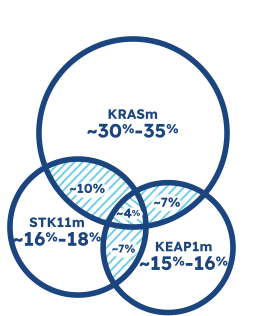
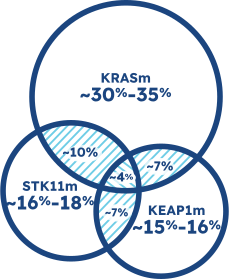
KRAS-mutant: Heterogeneous group, leads to
inconsistent outcomes9,10
STK11-mutant: May signify immune suppression within the
tumor microenvironment and rapid tumor progression10,13,14
KEAP1-mutant: May be associated with poor prognosis6
¶Prevalence rates are based on a retrospective real-world analysis using a nationwide clinicogenomic database of 12,934 patients with advanced NSCLC diagnosed between January 2012 and June 2021.12
ICI=immune checkpoint inhibitor; KEAP1=Kelch-like ECH-associated protein 1; KEAP1m=Kelch-like ECH-associated protein 1 mutation;
KRAS=Kirsten rat sarcoma viral oncogene homolog; KRASm=Kirsten rat sarcoma viral oncogene homolog mutation; mNSCLC=metastatic non-
small cell lung cancer; NSCLC=non-small cell lung cancer; PD-L1=programmed death-ligand 1; RCTs=randomized controlled trials; SEER=Surveillance, Epidemiology, and End Results; STK11=serine/threonine kinase 11; STK11m=serine/threonine kinase 11 mutation.




 This product information is intended for US Healthcare Professionals only.